What Does an AI-Generated Article Really Cost? BYOK vs SaaS Subscriptions (2026)
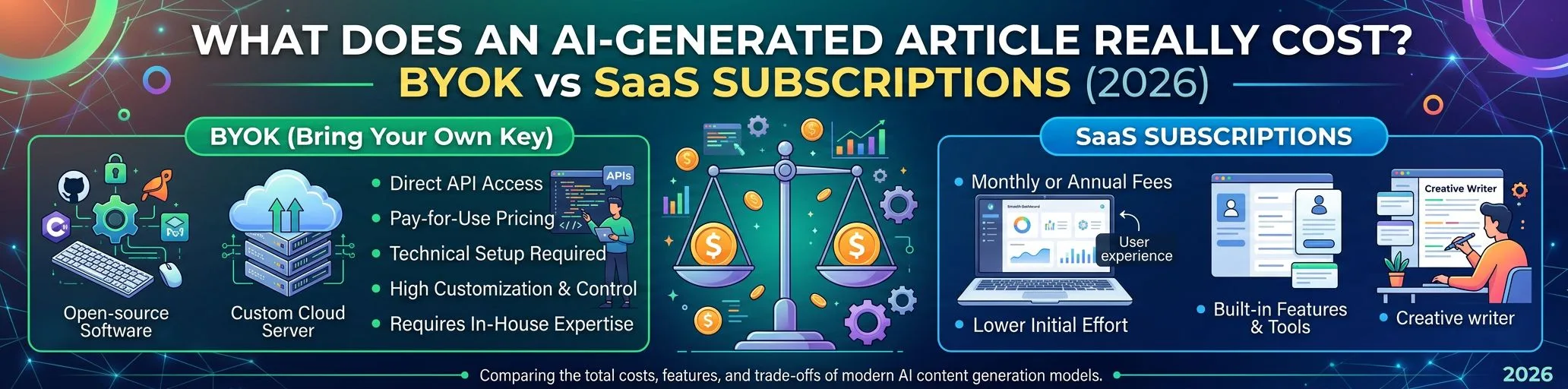
Ask an AI writing SaaS what an article costs and you’ll get a subscription tier. Ask the AI providers themselves and you’ll get a number 10–50× smaller. The gap between those two numbers is the SaaS markup — and understanding it is the single highest-leverage cost decision a content publisher makes in 2026. This article breaks down the real cost of an AI-generated article: the per-article API price, the true price of subscription models, and when each approach makes sense.
The Raw Numbers: What AI Providers Actually Charge
A typical 1,500-word SEO article consumes roughly 2,000–2,500 output tokens plus prompt overhead (keyword research, instructions, source material — call it 3,000–8,000 input tokens). At mid-2026 API pricing, per article:
| Model class | Approx. cost per 1,500-word article |
|---|---|
| Open models via OpenRouter (Llama, DeepSeek, Qwen) | $0.003–0.01 |
| Gemini Flash-class | $0.01–0.03 |
| GPT mid-tier | $0.03–0.10 |
| Claude Sonnet-class | $0.05–0.15 |
| Add: AI images (2–3 per article) | $0.02–0.15 |
| Add: keyword research query (Perplexity Sonar) | ~$0.005–0.01 |
Fully-loaded realistic total: $0.03–0.30 per illustrated, keyword-researched article — paid directly to Google/OpenAI/Anthropic/OpenRouter at their list prices. (Model trade-offs beyond price are covered in Gemini vs GPT vs Claude.)
What SaaS Subscriptions Actually Cost per Article
AI writing SaaS platforms typically price by words, credits, or article counts:
- Entry tiers: $29–49/month for ~30,000–50,000 words → roughly $1–2.50 per 1,500-word article
- Mid tiers: $99–125/month for “unlimited” words with fair-use caps or throttled models
- Per-article tools: $5–25 per article for “one-click SEO article” services
So the same article costs $0.05 in API usage or $1–5 through a SaaS — a 20–100× markup. That markup does buy something: the interface, prompt engineering, templates, and support. The question is whether it should scale with your volume.
The Crossover Math
Say your workflow needs 40 articles/month:
| SaaS ($49/mo tier) | BYOK desktop app | |
|---|---|---|
| Software | $49/mo | flat license / subscription (e.g. one Premium plan) |
| AI usage | included (capped) | ~$2–6/mo at your provider |
| 40 articles/mo | at or over the word cap | no cap |
| 200 articles/mo | forces the $125+ tier | ~$10–30/mo AI usage, same software cost |
The pattern: SaaS costs scale with volume; BYOK costs barely move. For 5–10 articles/month the difference is pocket change and SaaS convenience can win. Past ~20 articles/month — every agency, affiliate portfolio, and serious blog — BYOK dominates, and the gap widens with every article. For multi-site operators the effect multiplies: unlimited sites, one pipeline, your keys.
What “BYOK” Means in Practice
Bring Your Own Key: you create API keys directly with AI providers (Google AI Studio, OpenAI, Anthropic, OpenRouter — each takes ~3 minutes, pay-as-you-go), and your software uses them. Consequences:
- You pay list price — no reseller layer
- You see exact usage in the provider’s dashboard, per key
- You choose the model per task — cheap for drafts, premium for pillar pages
- No word-count anxiety — no burning credits on regenerations or experiments
- Your keys, your data — prompts and content don’t route through a middleman’s servers (pairs naturally with the desktop model)
The Hidden Costs Nobody Puts on the Pricing Page
Honest accounting includes more than tokens:
- Editing time. Every AI article needs a human pass (here’s why) — 10–30 minutes. At any reasonable hourly value this dwarfs token costs, which is another argument against also paying a per-word markup.
- Regenerations. Real workflows regenerate sections and test angles. On credit-based SaaS, every retry burns quota; on BYOK it costs a fraction of a cent.
- Tool sprawl. A typical stack — AI writer + scheduler + design tool + keyword tool — runs $100–200/month across subscriptions. Consolidated all-in-one pipelines (generation + social repurposing + publishing) collapse that line item.
When SaaS Still Makes Sense
To be fair: SaaS wins for very low volume (under ~10 articles/month), for teams needing browser-based real-time collaboration, and for people who genuinely won’t create an API key. If that’s you, a $29 tier is fine. Everyone else is subsidizing the middleman’s margin at scale.
FAQ
Are API costs predictable? Yes — providers show per-request costs, and you can set hard spending limits on every key. A busy month of publishing rarely exceeds $10–30 in AI usage.
Isn’t managing API keys technical? It’s a one-time, 3-minute copy-paste per provider. Modern BYOK apps have a settings field and a test button; that’s the whole setup — see the 10-minute walkthrough.
What about the software cost itself? BYOK apps charge for the software, not the AI. In SEO Content Architect, article generation is free forever with your keys; Premium adds publishing automation, Bulk Engine, Social Studio, and the Distribution Hub.
Do open models via OpenRouter cut quality? For standard informational articles, surprisingly little — and at $0.003–0.01 per article, testing them on your niche costs essentially nothing.
Stop paying per word: SEO Content Architect is a Windows desktop app where you generate unlimited SEO articles with your own Gemini, GPT, Claude, or OpenRouter keys. Download free from the Microsoft Store.